Petiole testing tells a grower whether the crop has enough nitrogen during the season. The target is not fixed. It falls as the crop moves from tuber initiation to bulking and maturity.
North Dakota State University publishes sufficiency values for petiole sap nitrate in irrigated Russet Burbank. They are in publication SF715, revised in January 2021:
- 15–30 June, vegetative growth and tuberization: 1,200–1,600 ppm;
- 1–15 July, tuber growth and bulking: 800–1,199 ppm;
- 15 July to 15 August, bulking and maturation: 400–799 ppm.
The University of Minnesota Extension gives the same early range of 1,200–1,600 ppm. Its later ranges are slightly narrower: 800–1,100 ppm for early July and 400–700 ppm from mid-July to mid-August. The page was reviewed in 2024 by the extension specialist Carl Rosen.
Weekdays. Unsubscribe in one click.
When the crop takes up nitrogen
Minnesota advice puts peak nitrogen uptake between 20 and 60 days after emergence. Growers should plan most nitrogen inputs from 10 to 50 days after emergence. One third to one half of the recommended rate can go on at or around emergence, with starter nitrogen banded at planting.
A University of Idaho guide for Russet Burbank gives a similar picture. About 50 to 60 percent of the total nitrogen requirement should be applied by the time the rows close, it says.
Yield goals are no longer the basis
The two Midwest services differ on one point. North Dakota dropped yield goals from its fertilizer advice. Research has shown that no link exists between expected yield and nitrogen rate, the university wrote. Its rates now depend on variety type and vine-kill date. Minnesota tables still group rates by yield goal and previous crop. For example, a 400–449 cwt/acre goal after alfalfa on low organic matter soil gets 100 lb N/acre. After a Group 2 crop, the rate is 160 lb N/acre.
Why it matters
Too little nitrogen during bulking cuts yield. Too much late nitrogen delays maturity and skin set, and it can lower dry matter. Petiole ranges give a simple weekly check between these two risks.
The ranges apply to one variety under irrigation in the Midwest. Other varieties and climates need local calibration. Sampling method also matters. Growers should use the same petiole position and the same laboratory each week, so that the trend is reliable.
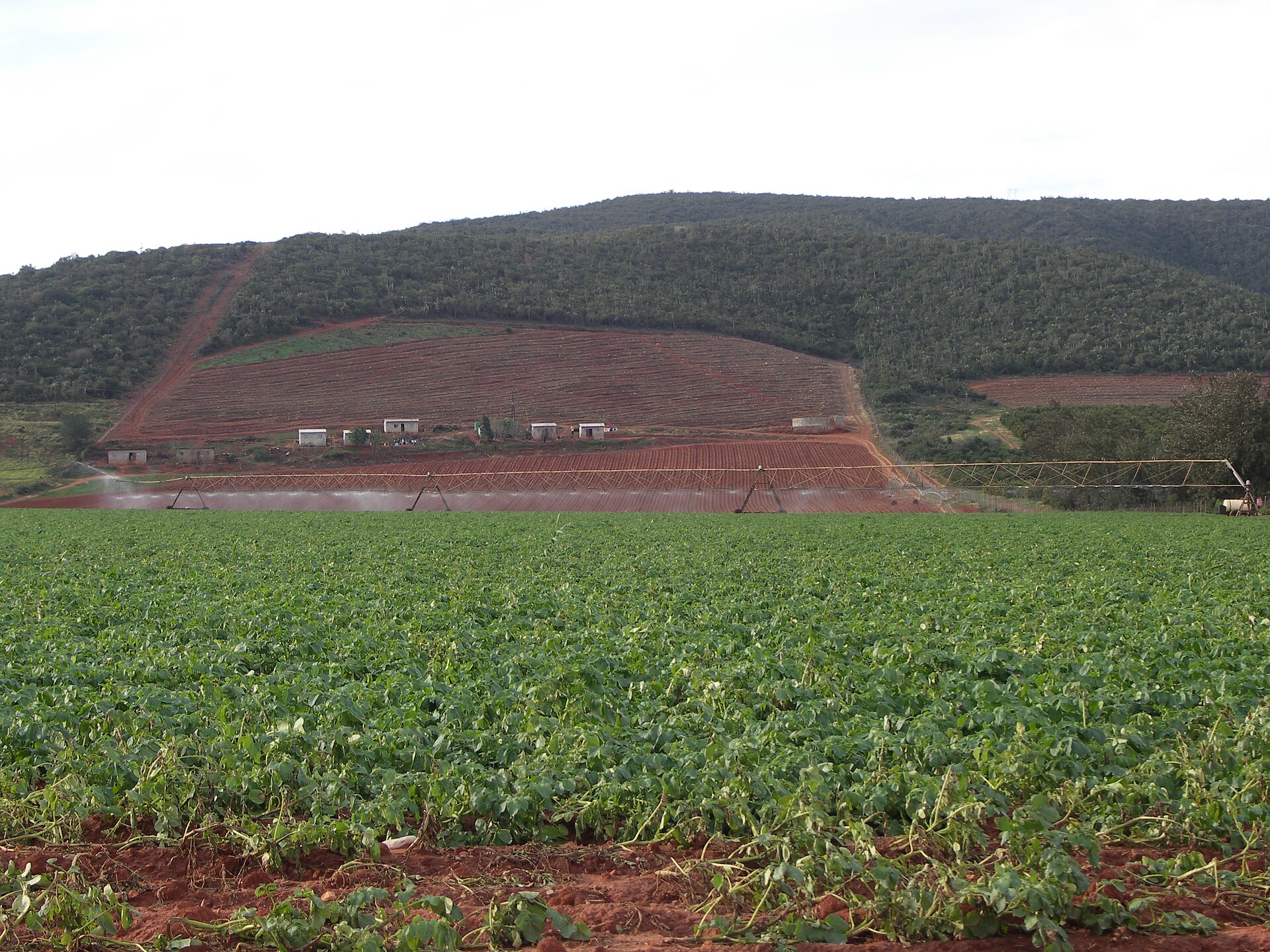
Photo: A potato field under centre-pivot irrigation near Patensie, South Africa (illustrative). NJR ZA / Wikimedia Commons, CC BY-SA 3.0