A Russian Potato Union notice about VNIICR’s educational work has brought Potato virus Y back into the industry’s discussion. The practical issue for seed and ware growers is how to connect crop inspection, laboratory diagnosis and the known transmission pathway, rather than treat one symptom or one general loss figure as a complete assessment.
Symptoms are a warning, not a universal identification rule
MKS Union’s 4 November 2026 notice points readers to a VNIICR educational video on the pathogen. For the diagnostic detail, Cornell’s PVY resource explains that expression varies with virus strain, cultivar and environment. Some infections can produce conspicuous foliage or tuber symptoms; others may show only mild leaf symptoms.
That variation is why appearance alone cannot establish the condition of a whole seed lot. Cornell describes laboratory confirmation using appropriate plant or tuber material. The useful investigation keeps the crop, sampled tissue and diagnostic question together.
Hafta içi. Tek tıkla abonelikten çıkın.
Transmission changes the management question
Cornell'in aphid-vector rehberlik explains that PVY can be acquired and transmitted within seconds during brief probes. Both aphids that colonise potatoes and those that move on after probing can be involved. This non-persistent transmission differs from a simple model in which killing a settled pest necessarily prevents virus introduction.
The guidance specifically distinguishes aphid control from preventing virus inoculation by incoming winged aphids. A general promise that an insecticide programme will stop PVY is therefore too broad. Any intervention still needs locally appropriate advice, authorised use and evidence for the intended purpose.
Connect the seed lot with field sources
MKS AHDB question-and-answer resource identifies input seed, infected neighbouring potato crops and groundkeepers among relevant sources to investigate. It also discusses laboratory testing methods and the interpretation of aphid information.
For a seed business, a useful evidence record includes lot identity, source, sampling and the test applied. For a grower, field observations should be traceable to the planted lot and the location where symptoms were found. Those records make a discussion with a diagnostic laboratory or adviser more precise.
Make the production decision from the relevant evidence
Reported losses in a severe infection scenario should not be treated as a forecast for every field. The practical assessment needs the pathogen finding, infection context, variety and intended use of the crop. Seed multiplication and a ware contract can impose different questions and acceptance requirements.
The renewed educational attention is useful when it leads to that connected process. Inspect the crop, confirm the diagnosis where needed and review the evidence attached to planting material. The objective is an informed seed-health and crop-management decision, with uncertainty identified, rather than a diagnosis from a picture or an unsupported promise of complete protection.
Kilit noktaları
- PVY symptoms vary, and mild foliage symptoms can complicate visual assessment.
- Brief aphid probes can transmit the virus before a simple pest-control assumption applies.
- Keep seed-lot records, field inspection and suitable diagnostic testing connected.
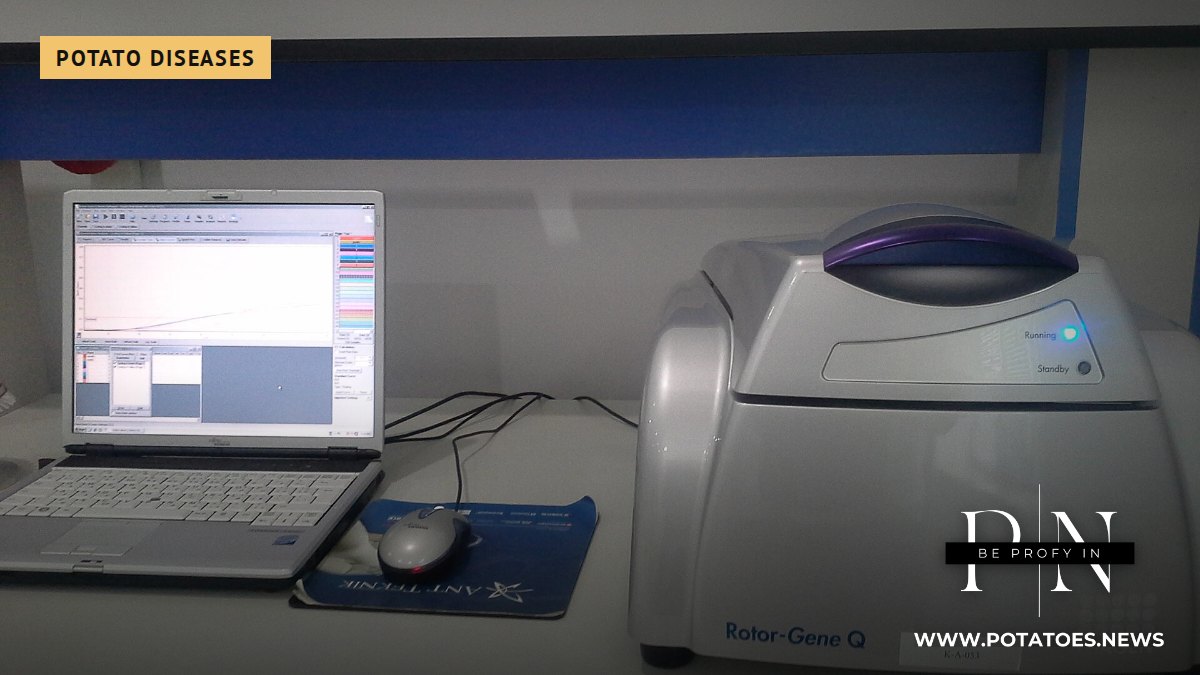
Illustrative real-time PCR equipment. Photo: İnformatic / Wikimedia Commons, CC BY-SA 3.0.